2010 Polaris Scrambler 500:
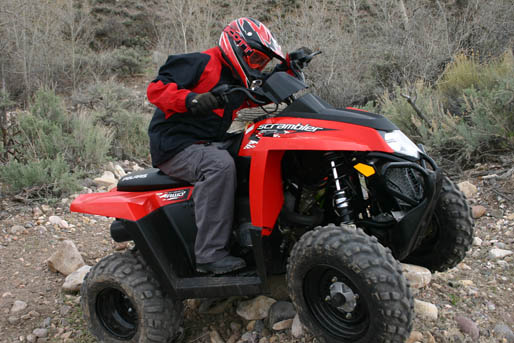
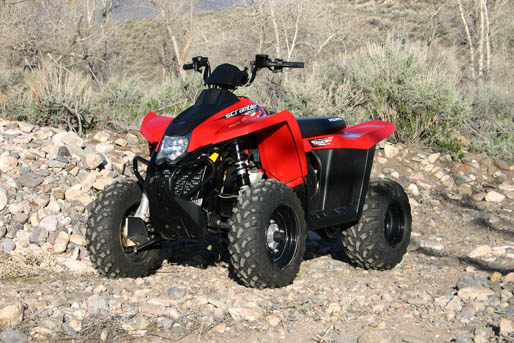
There are just some things in this life you can’t seem to categorize. The Polaris Scrambler is one of those. From a distance the Scrambler looks kinda like a sport quad with its sharp angled and trimmed fenders sitting high above the small diameter tires. But as you get closer, rather than being a small and light weight 2wd machine with a low center of gravity, you discover it’s actually a big machine that’s also both quite tall and woefully heavy. Although there’s a swingarm at the rear for suspension, as well as a chain drive and a disc brake, up front you’ll find struts rather than the anticipated a-arms. Plus it has floorboards rather than footpegs, and four-wheel drive. And unlike sport quads, it has a single-lever braking system.
Okay so it’s not a sport quad. But it’s not really any kind of a utility machine either. First of all, there’re no front and rear racks and the fenders are so small they couldn’t even keep the dust from those little 23” tires off of the rider, let alone mud or snow! Plus there’s no low range. And it has a chain drive.
So here’s where we give up trying to figure out exactly what the Scrambler is or what the purpose for its very existence is, and just hop on and take it for a spin.
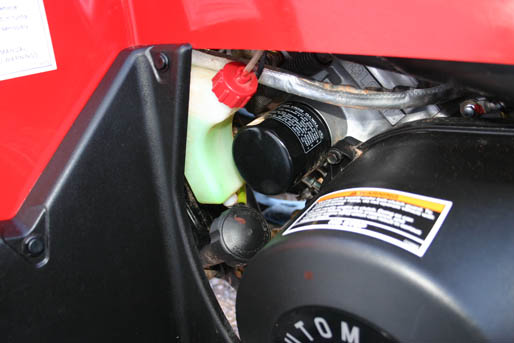
Swing a leg over the Scrambler and either put the CVT transmission in neutral or hold the brake while it’s in gear and twist the key to start the big 498cc 4 stroke single. Whoops, did we mention that it’s carbureted so if it’s cold outside you might also need to pull the choke lever? Once started all you need to do is give the thumb throttle a push to get the Scrambler moving. And once moving you’ll once again be wondering what this machine is for. It’s quick, but not really any quicker than the latest Sportsman 550XP. It seems to handle pretty well, but not really noticeably better than the XP. It’s also very comfortable, but again, not any more plush than the XP.
Confused? So are we. The Scrambler was introduced back in 1995 as a 400cc 2-stroke. It was such a hit that in 1997 Polaris released a big bore 4-stroke version, the Scrambler 500. At that time (in case you weren’t born yet) sport quads were nothing like they are now. So when Polaris introduced the 2-stroke Scrambler 400 and later the big bore 4-stroke Scrambler 500 they were really big news! Here was a big bore sport quad with 4wd. It was no Banshee that’s for sure, but it also definitely wasn’t anything like a 1997 utility quad either!
Obviously times have changed. Today’s utility ATVs can probably outrun and out-handle many of the sport quads from that time. So where does that leave the Scrambler? It is basically unchanged since its introduction and obviously more than ready for an update.
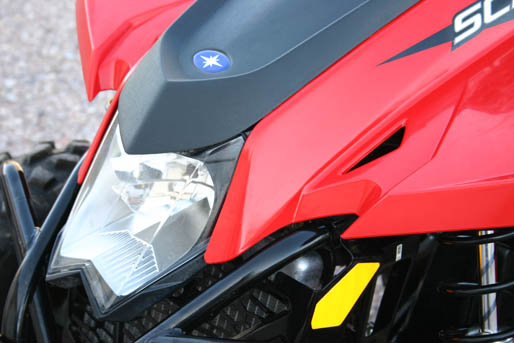
For 2010 Polaris finally gave the Scrambler that much needed update. Walking up to the Scrambler, it’s easy to spot the visual changes for 2010. You quickly notice the new-for-2010 plastic with a bit edgier look and more creases ironed in. The floorboards are now a more integral part of the fenders. Also part of the facelift is the new headlight now molded into the nose rather than up on the bars like a Baja racer. The front bumper has been modified, now being a bit larger, the seat has been fluffed up for added comfort, and a gas gauge has been added to the top of the now 4-gallon tank.
Less noticeable but perhaps more important are the modifications to strengthen the frame and add thicker skid protection to the underside. The front struts have been modified to allow for separate front spindles and the springs have been changed front and rear to soften the ride and lower the Scrambler a little over a half an inch. That suspension sag has the added benefit of increasing the wheelbase a half-inch to 48.5. More than just longer and lower, the new Scrambler is also wider, thanks to a quarter inch more offset in each wheel. Amazingly enough, even with this list of revisions, the 2010 Scrambler is still remarkably similar to the old model it replaces. But that’s not necessarily bad.
The riding position is comfortable and feels much more like a utility machine than a sport quad, with the thickly padded seat and the tall bars allowing a much more upright seating position than the typical crouched sport position.
Out on the trails, the CVT transmission seems to hook up pretty well. Although the big 4-stroke has ample power for everyone but the most power-hungry riders, it’s delivery could be more responsive at throttle tip-in. The lazy power delivery is most likely due more to the CVT transmission’s settings and the carbureted fuel delivery than the weight of the machine. The weight does show itself when the trail turns though, as once you need to change the direction of the Scrambler, it requires a lot of effort on the rider’s part. So although the Scrambler has the comfort and grunt of a Trophy truck on the more open trails, it also has the same lazy handling and lack of desire to change direction when the turns approach.
When the throttle is chopped, the engine braking is darn near perfect in its application. It is far less noticeable than the artificially induced braking that’s so prevalent on many of the utility CVT equipped ATVs including other Polaris’. That means it works well for aggressive riding. Letting off of the throttle results in a decreasing speed coast down rather than the abrupt, throw you forward, with the rear tires skidding that’s too often dialed into CVT transmissions in an effort to keep you from having to use the brakes themselves. The braking downfall is the combination of a single lever brake system that doesn’t allow full control when entering corners hard, and the rear brake pedal that’s raised so high above the floorboards that your boot fits underneath it more comfortably than operating it!
So although we headed into this test more than a little perplexed at what exactly what purpose the Scrambler served, after just a few hours on the trails we didn’t really care about where it fit. The Scrambler is a blast to ride, and while we were riding, that’s all that mattered. Once we got back to the shop we realized that, like the KFX700 or the Renegade, the Scrambler blends and blurs the distinction between sport and utility in an effort to provide a comfortable and capable machine for the recreational rider. Comfortable due to its soft, upright seating and pliable suspension even at slower speeds, and capable due to its 4 wheel drive traction! Add in the fact that Polaris offers accessories like trailer hitches and racks for the Scrambler and it only makes the purpose more obscure. And perhaps that is the bottom line! Perhaps the Scrambler’s true mission is to completely obliterate the line between sport quad performance and a utility quad’s capability.
Whatever the case, it’s fun! And that my friends is what it’s all about!