2010 POLARIS RZR $ ROBBY GORDON EDITION
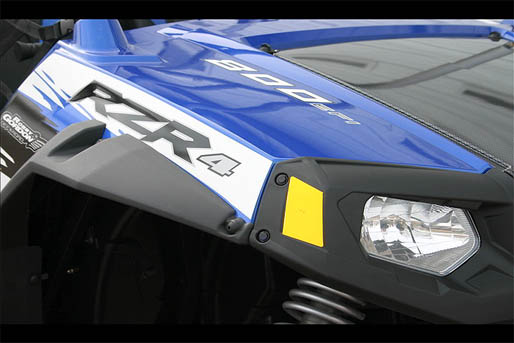
When Polaris introduced the RZR back in early 2007 they forever changed the benchmark for what we would expect from a side by side. Then in 2009 Polaris introduced the RZR S, a performance-oriented RZR that came right off of the dealer’s showroom floor with long travel A-arm suspension, Fox shocks, and 26” Bighorn radials on nice aluminum wheels. For 2010 Polaris has lengthened the RZR S and added a second row of buckets to make the RZR 4, the first 4-seat performance side by side.
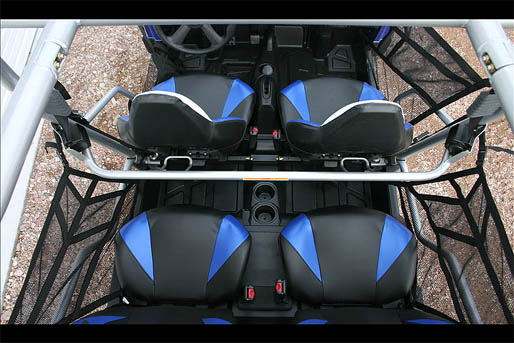
If you are familiar with the RZR S then most of the features and specifications will be easily recognizable. So let’s start with what’s different. It’s longer and has 4 seats! Okay, we’ll get just a bit more specific than that. The standard RZR frame has been lengthened 26 inches and strengthened in the process to handle the added stress that the added length creates. Directly behind the front pair of buckets is an additional set of the same, adjustable fore and aft seats identical to the fronts. Behind the front seats is a full-width grab bar for the passengers to hold on to.
As before the RZR offers you the ability to adjust the seats fore and aft. Although not quite as easy as a sliding lever like you find on your car, you can pull the seat from the RZR and by loosening 4 torx-head screws slide the seat forward or back. And there’s enough adjustment to provide a comfortable seating position for just about everyone. Also helping in that department is the tilt wheel. Simply pull the lever and a hydraulic shock allows the wheel to tilt up for easy egress and seating for the big and tall group, and down for easy reach by those of us in the category of short and thin. And while we’re discussing the steering wheel, it has a pair of bulges at 10 and 2 o’clock that help make it comfortable to grip, even in tough going.
The dash layout and gauges remain the same with a large dial speedometer with the odometer, trip odometer, hour meter, tachometer, clock, fuel gauge, and drive position all located inside the face. On the dash are the switches for the headlights and the all wheel drive system, along with a 12-volt accessory plug. On the passenger’s side you’ll find the same great adjustable t-handle that’s typically found only in race buggies and sand cars.
Thanks in part to the RZR S, Polaris had already strengthened the frame around the front and rear suspension points as well as the rear suspension and shock mounts to better withstand the stress applied from adding long travel arms. The front and rear suspension on the RZR 4 uses the same set-up as the RZR S with dual a-arms with 5-way preload adjustable Fox Podium shocks at each corner with 12” of suspension travel. The ground clearance is 12 inches with 26 inch Maxxis Bighorn radial tires mounted on 12” aluminum wheels. And the brakes are discs at each wheel.
Powering the new 4 is the same liquid-cooled, fuel injected 760cc twin cylinder H.O. engine as in the S model, putting out 55 horsepower and propelling the RZR to a top speed of 61 mph. The transmission is the same CVT unit found in the other RZRs that has Park at the forward position, Reverse one notch back, then neutral in the center, with the low range one more notch back and high all the way to the rear.
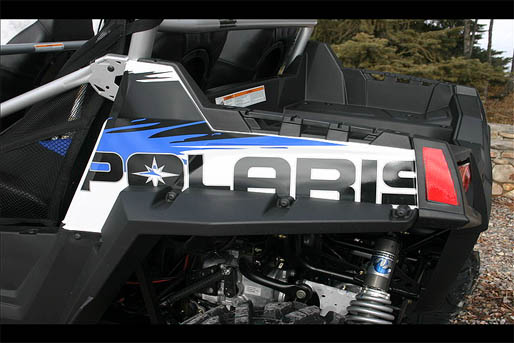
The RZR 4 has a dry weight of 1255 pounds. The carrying capacity and tow rating are the same as the 2-seaters being rated to carry 300 pounds in its 42” by 22” bed, and tow 1500 pounds using the slide-in hitch receiver system. The bed is also equipped with Polaris’ unique Lock N Ride cargo latching system.
So, how’s it work you ask? Just wonderful.
Oh, you want more than that?
Well, here’s our findings?
The Good: The 4 handles almost scarily good in the rough terrain. I say scarily because I think that this thing handles so incredible that by the time you find yourself running out of talent, you’re gonna be in really big trouble. 60 inches of width, 103 inches of wheelbase, and 12 inches of well-damped travel will do that. The ride is cushy soft. And with the engine moved farther behind the driver, it’s a very quiet ride.
The steering is accurate thanks to the well-balanced chassis and the Maxxis tires. Even with the longer wheelbase you can control the direction that the front end points with the throttle. The adjustability of the rear shocks make it possible to adjust the weight balance whether you running 2 light-weight passengers, or 4 heavy-weight ones.
The Bad: At 60 inches wide it obviously doesn’t fit on my favorite 50” trails. And with a 103-inch wheelbase it doesn’t maneuver the tight trails very well and can be an absolute pain to try to turn around when you do run out of space. And with that tall cage it’s not only God-awful ugly, but it doesn’t fit in normal enclosed trailers.
And like all RZRs, the shifter is still far too glitchy and it really, really needs a parking brake! And speaking of need, I don’t know who was responsible for the so-called throttle fix, but I think it’s more aggravating than the previous models. And as always, the engine braking needs to be better – that means less noticeable not more powerful.
The Bottom Line: With all that said, if you can find a better and more comfortable way for 4 people to explore the back country trails and shoot through the sand dunes for this price, let me know. Until I hear from you I’ll be spending time with my family and friends in my RZR 4.